Canary Seed Agronomy
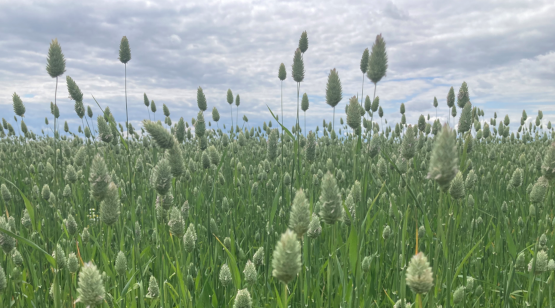
Agronomy
Canary Seed can be grown anywhere in the UK South of North Yorkshire, when going North of here maturity can be a problem. Most commonly its grown in East Anglia on heavy land as part of a Blackgrass control strategy, however success has been had nationwide.
Moisture retentive soils (not very light sands). Fields should be free of Couch and adequately cultivated.
Mid-March - late April when soil is warming. If moisture is not a limitation, then May plantings are acceptable.
As for cereals.
Sow shallowly into moisture. Canary Seed is small, so rolling is often beneficial. If using Avadex for grassweed control, planting should be at 2.5 cm to give adequate depth protection.
Canary Seed is similar in size and shape to Linseed seed and slightly fatter. Average Thousand Grain Weight (TGW) for Canary Seed is in the range 7 to 8 grammes.
Target plant population after establishment is around 300 to 350 plants per m2 and, depending upon seed bed conditions, growers should aim to sow 400 to 450 seeds per m2 to achieve this.
At 8g TGW a sowing rate of 35kg/ha will represent around 430 seeds/m2.
There are EAMUs in place for: Avadex Excel 15 g (grassweeds), Starane Hi-Load HL (broadleaf weeds) and Mircam Plus (broadleaf weeds). There is no post emergent control of grass weeds in Canary Seed. See the EAMU box for product links.
An insurance application of growth regulator is recommended. Canary Seed has an EAMU for Optimus and Stablian750. See the EAMU box for product links.
The only pests are aphids in the ear - an EAMU exists for Teppeki. In milder spring years we have found an increased number of slugs, pellets should be applied at growers discression. See the EAMU box for product links.
Disease issues are rare. Powdery Mildew can be found in the bottom of the crops, in cases where it progresses up the crop canopy to the flag leaf Cyflamid on EAMU is approved. See the EAMU box for product links.
Canary Seed has a low demand for fertiliser.
There is some evidence that Canary Seed will respond well to Potassium, which should be applied to the seedbed. Typical rates are 25 - 30 kg/ha depending on the index.
Nitrogen can be applied and incorporated into the seedbed, after drilling or after crop emergence as convenient. Demand is low, but for index 0 situations (following a straw crop and with no recent organic manures) 60 kg/ha is adequate. If the farm has a known Sulphur deficiency this needs to be corrected.
Manganese and Copper may be required if deficiency is common on the farm.
Data from Canada has suggested that Chloride was found to reduce seed abortion and help grain filling. Responses were seen when canary seed was stressed or under high yielding conditions.
1.0 - 1.5 m.
Late August - early September. At harvest the seeds will be hard, like Cereal seeds.
To ensure an easy harvest, crops should be sprayed with a high rate of Roundup pre harvest. Direct combine. Canary Seed does not shed its seeds, so patience is required. Canary Seed needs a good thrash to free the grains from the ears but avoid skinning the grains as this may reduce the value of the crop. Typically, 5% of skinned grains is permissible. See the EAMU box below for product links.
12% moisture, 2% admixture.
Likely range 2.0 - 3.0 t/ha.
Canary Seed straw has a similar value to rough hay.
Health and Safety Data Sheets
Please click on the links below to download the relevant H&S Data Sheets for our seed treatment products.
Detailed below are the products listed by the Health and Safety Executive as having an Extension of Authorisation for a Minor Use of a Plant Protection Product. (EAMU)
It is essential that anyone who needs to use a product in accordance with an Extension of Authorisation must read the text of the Extension of Authorisation before commencing any spraying operation. Links are provided below to the Authorisation document for each of the products.
All products below were Authorised at the time they were added to this list, while Premium Crops do regularly check the validity of the products and update the list accordingly, it remains the Grower's responsibility to make sure that the Authorisation remains valid at the time any product is used.
Avadex Excel 15G (triallate) Gowan Crop Protection Ltd
Avadex Factor (tri-allate) Gowan Crop Protection Ltd
Cleancrop Cutlass (trinexapac-ethyl) Masstock Arable (UK) Limited
Cyflamid (Cyflufenamid) Certis
Mircam Plus (dicamba, MCPA and mecoprop-P) Nufarm UK Limited
Optimus (trinexapac-ethyl) Nufarm UK Limited
Roundup Energy (glyphosate) Monsanto UK Ltd
Roundup Klik (glyphosate) Monsanto UK Ltd
Roundup POWERMAX (glyphosate) Monsanto UK Ltd
Stabilan 750 (chlormequat) Nufarm UK Limited
Starane Hi-Load HL (fluroxypyr) Dow AgroSciences Limited
Teppeki (flonicamid) Certis Belchim B.V.
Teppeki (flonicamid) Certis Belchim B.V.
The above is a list of all products listed on the HSE website and as such does not represent Premium Crops' endorsement or recommendation for use.
Please note an EAMU does not ensure a product is safe to use.
Visitors also searched for

Spring Linseed
Flexible spring break, perfect for following with wheat.
Cover Crops
Improve soil health and boost spring yields with our autumn mixes.
Millet
Late drilled, drought resistant and low input.