Millet Agronomy
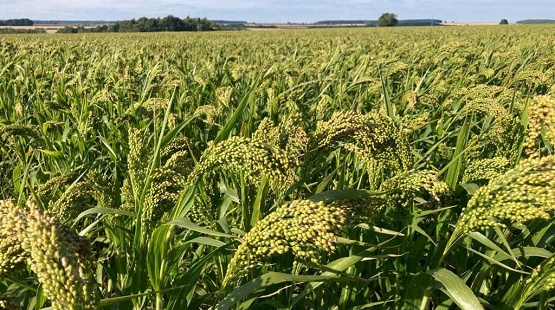
Agronomy
Millet can be grown anywhere in the UK South of North Yorkshire, when going North of here maturity can be a problem.
Millet is a C4 plant (like Maize) and is very efficient in its use of water, which means that it is very drought resistant. It is particularly suited to light and medium soils. Avoid soils likely to become waterlogged.
Millet does NOT grow well at low temperatures, but really does well as temperatures increase. At planting the soil temperature needs to be a minimum of 10ºC, but 15ºC is better to ensure a very rapid emergence and establishment. The sowing window is likely to be late April through May.
As for cereals.
Maximum depth of 2.5cm deep into a warm and moist seed-bed. Rolling is beneficial to improve seed-to-soil contact.
20-25 kg/ha. Millet seed is about the size of OSR.
There are EAMUs in place for Peak and Starane Hi-Load HL for broadleaved weeds. There is no post emergent control of grass weeds in Millet. The late sowing give excellent options for sterile seedbeds and cultural control of grassweeds.
See the EAMU box for product links.
Not required.
Slugs and leather jackets may cause issues, but Millet is resistant to Rabbit and Pigeon grazing.
Not normally a problem. Rhycosporium type lesions may be seen on some leaves in some seasons. Control is not usually justified and there are no fungicides cleared for use on the crop.
P, K and S - typically as for Spring cereals and should be applied to the seedbed. Nitrogen can be applied and incorporated into the seedbed 1 week before drilling or split pre and post emergent. Nitrogen demand is low, but for index 0 situations (following a straw crop and with no recent organic manures) 80-100 kg/ha is ample.
Treat accordingly if deficiencies are common on the farm (routine on chalk soils).
1.0 - 1.5 m.
From mid-September. At harvest the seeds will be hard, like Cereal seeds.
Desiccate mid to late August to even out the maturity of seeds. An EAMU is in place for Roundup. Direct combine, Harvest is likely to be 3 weeks after desiccation. Millet does not shed its seeds, so patience is required. Millet combines like a Cereal. Be guided by the seeds not the foliage – even damp stems flow through the combine easily.
See the EAMU box for product links.
13% moisture, 2% admixture.
2.5 – 3.5 t/ha likely range.
Can easily be chopped and incorporated.
. Most crops will be harvested in the 15 – 18% moisture range so will need drying. Millet needs to be dried quickly, so the use of a batch or continuous flow drier is ideal. Premium Crops does offer drying facilities.
Health and Safety Data Sheets
Please click on the links below to download the relevant H&S Data Sheets for our seed treatment products.
Detailed below are the products listed by the Health and Safety Executive as having an Extension of Authorisation for a Minor Use of a Plant Protection Product. (EAMU)
It is essential that anyone who needs to use a product in accordance with an Extension of Authorisation must read the text of the Extension of Authorisation before commencing any spraying operation. Links are provided below to the Authorisation document for each of the products.
All products below were Authorised at the time they were added to this list, while Premium Crops do regularly check the validity of the products and update the list accordingly, it remains the Grower's responsibility to make sure that the Authorisation remains valid at the time any product is used.
Peak (prosulfuron) - Syngenta UK Limited
Roundup Energy (glyphosate) - Monsanto UK Ltd
Roundup Klik (glyphosate) - Monsanto UK Ltd
Roundup POWERMAX (glyphosate) - Monsanto UK Ltd
Starane Hi-Load HL (fluroxypyr) - Corteva Agriscience UK Limited
The above is a list of all products listed on the HSE website and as such does not represent Premium Crops' endorsement or recommendation for use.
Please note an EAMU does not ensure a product is safe to use.
Visitors also searched for
Spring Naked Oats
Husk-less oats earn a premium above market rates.
Canary Seed
Low input, low labour, high margins - sustainable spring break.
Spring Linseed
Flexible spring break, perfect for following with wheat.